
Quantcast
Latest Stories

Controversial documentary goes home to Cebu

MANILA, Philippines—Fifteen years ago, two girls went missing and set off a series of events that led to what would later be called “ Cebu ’s trial of the century.”

While waiting for their father to pick them up, sisters Marijoy and Jacqueline Chiong disappeared at a mall in Cebu . Accused of their rape and murder was Paco Larrañaga, a culinary arts student whose whereabouts that day had been confirmed by dozens of witnesses and photographic evidence. He was in Manila, 300 miles away from Cebu , and couldn’t have been anywhere near the victims.

There was a deafening clamor for immediate justice, not just in Cebu but throughout the country. So in a dramatic turn of events, the judge favored the plea of the Chiong sisters’ family and convicted Paco and six others for life imprisonment, a verdict which was eventually raised to death penalty due to pressure from the public and widespread media attention.

The trial became a game of chess where many players were involved and people kept moving their pieces. In the end, Paco was checkmated—he was imprisoned in Bilibid for years, his fate celebrated by many as it was seen as a triumph. He was not given a chance to speak or defend himself.

More than a decade since, filmmakers Marty Syjuco and Michael Collins give him a voice. They revisit old wounds and step into the many thorns of the Philippine justice system in their critically acclaimed documentary, Give Up Tomorrow. In addition to building a strong case for Paco’s innocence, the film exposes the messy scheme of events that surrounded the trial, revealing the interconnected complexities that permeate Philippine politics and culture.

Disclosing a collection of interviews with forensic experts, political analysts, and major players in Paco’s case, not to mention controversial pieces of evidence that were left uncovered for a long time, Give Up Tomorrow brings to light the lack of due process and the elaborate frame-up done through a shameless display of political favors.

The documentary begs the terrifying question: What if the so-called Cebu ’s trial of the century was actually a mistrial?

Due to the film’s controversial subject, Syjuco and Collins had some trouble finding local venues for a commercial screening. In fact, no cineplex dared to screen it in Cebu , even for a premiere night. So the filmmakers, together with a small group of undaunted people, worked hard to bring it to Cebu , where it all began under the worst of circumstances. Finally, after touring the world’s film festivals and reaping laurels left and right, Give Up Tomorrow came home to Cebu and had its very first screening there last Wednesday, September 26, at the Marcelo B. Fernan Press Center.

In Metro Manila, some theater managers fortunately realized how important it is for many Filipinos to see this eye-opening documentary.Give Up Tomorrow will be screened exclusively at Robinsons Galleria and Robinsons Ermita from October 3 to 9, and at Trinoma, Greenbelt 3, and Alabang Town Center from October 5 to 7.

A regular theatrical run in Cebu may yet happen if enough Cebuanos are ready to revisit a traumatic past and call into question what has long been considered there as justice served.

With theatrical playdates in New York City on September 28 and Metro Manila on October 3, Give Up Tomorrow is screening in New York , Manila and Cebu all in the same week.
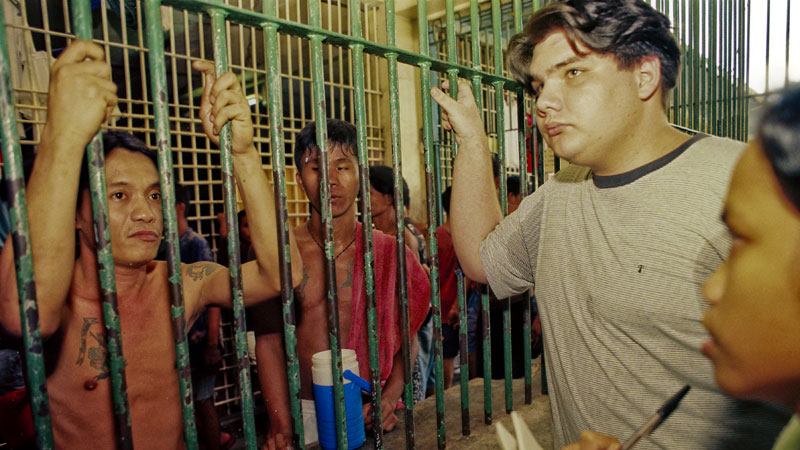
This file photo shows Paco Larrañaga behind bars, being interviewed by a news reporter, shortly after he was arrested for the kidnap, rape and murder of two sisters in Cebu City. ARNI ACLAO/Contributed Photo


Follow Us


Follow us on Facebook Follow on Twitter Follow on Twitter


Recent Stories:

Complete stories on our Digital Edition newsstand for tablets, netbooks and mobile phones; 14-issue free trial. About to step out? Get breaking alerts on your mobile.phone. Text ON INQ BREAKING to 4467, for Globe, Smart and Sun subscribers in the Philippines.

Tags: Cebu , cinema , Crime , Jacqueline Chiong , Marijoy Chiong , Paco Larrañaga

  • http://pulse.yahoo.com/_WYX4ZTAV4BUGW2RIMT45CPYBGA Pio Gante

    suicide or murder? mystery still shrouds the death of martin ocampo.

  • eorlando

    These filmakers just given a voice to a rich and powerful criminal – soldouts!  These rich criminals can afford a vigorous defense. Why can’t they give a voice to the Judge who was killed after he gave a guilty verdict? How many poor Filipinos who are wrongfully convicted because they can not afford a lawyer? Of all the millions of cases, these people given this criminal a voice?

    • CDurrr

      The trial was definitely controversial and political, I saw it made a lot of headlines in Cebu newspapers as I was growing up. The trial warranted a movie. Maybe the Chiongs should make a documentary debunking this?

    • http://profile.yahoo.com/7BK5T45PCE5XJMTUZJPN3X36PI Sheryl

      did you even watch the documentary???

  • concern_pinoy_citizen

    Paco is guilty 100%.  This filmed was financed by the Paco’s to twist the truth. What a shame!

  • http://pulse.yahoo.com/_ASBUCU7SQ4FD5BEPYSWVLWD4TQ Marge

    To be honest, I have followed the story and when I saw the film, I began to question the events that unfurled. I do not think the Larranagas are as rich as we might think, they are certainly well-to-do, but I do not believe that they would have so much money that they could charter a private plane from Manila to Cebu just so that Paco could rape and murder two girls (as what Judge Ocampo said before). What I found interesting in the documentary is the perversion of justice and how media could influence anything and everything. Just because one is mestizo, doesn’t mean they are floating in money. Just because one is rich, doesn’t mean that they should be mobbed by everyone when they are accused by someone who might be poorer, we shouldn’t be prejudiced. We need to look at the facts as we see them, and listen to all those who have something to say (I have to admit, I was shocked when in the documentary, I found out that Larranaga and the suspects were not even allowed to go to the witness stand, despite wanting to go so that they could be heard, while the one voice (Rusia, who is a convicted felon in the US, hence shouldn’t have even been declared a state witness for that fact alone) that spoke against them was given days to talk). Whether they committed the crime or not, what is certain is that they were not given a fair trial. Media and misled people essentially decided their fate.

  • eorlando

    per this article, these filmmakers have given Paco a voice, and my question is why HIM? – of all the faceless, voiceless and powerless convicts who may be innocent , these “filmmakers” just found the one that can more than adequeately defended himself through wealth, influence, and political power to provide voice to. Sold outs! Just the fact that he was transferred to Spain showed Paco’s influence.


Copyright © 2013, .
To subscribe to the Philippine Daily Inquirer newspaper in the Philippines, call +63 2 896-6000 for Metro Manila and Metro Cebu or email your subscription request here.
Factual errors? Contact the Philippine Daily Inquirer's day desk. Believe this article violates journalistic ethics? Contact the Inquirer's Reader's Advocate. Or write The Readers' Advocate:
c/o Philippine Daily Inquirer Chino Roces Avenue corner Yague and Mascardo Streets, Makati City, Metro Manila, Philippines Or fax nos. +63 2 8974793 to 94